
Equipment-sharing case studies
The Eastern Arc Equipment Sharing Platform allows staff and students across the consortium to access equipment at the other partners on a quid pro quo basis.
Examples of how this works in practice are given below. To find out more about the scheme and to apply to access equipment at another university, click on the links to the right. For any questions, contact us at info@easternarc.ac.uk.
Will Edwards
 Doctoral student Will Edwards was faced with a problem. He wanted to run some analytical tests to establish the protein content of black soldier flies, but the University of Kent didn’t have the necessary elemental analyser.
He talked about his options with his supervisor Anastasios Tasousis and co-supervisor Rob Barker. ‘The only option seemed to be investing £50k in a new analyser, or paying commercial rates for running the tests,’ said Will. And then Anastasios said, ‘Have you thought about Eastern Arc?’
Will hadn’t been aware of the opportunity available to those working in any of the consortium members. As part of a trial agreement, they could access equipment (primarily imaging equipment) and facilities at any of the four universities.
Will looked at what each university had, and saw that UEA had the equipment he needed: an Exeter Analytical CE440 elemental analyser. He dropped a line to Antony Hinchcliffe, Instrument Platform Manager at UEA, who was supportive and agreed to host him. He then got permission from the Director of Research for his department, and made a formal request from Eastern Arc to go ahead. The consortium provided the funding for him to travel to UEA and use their equipment.
‘It was a brilliant experience,’ said Will. ‘Antony was incredibly helpful, giving us the necessary training to use the equipment, and then allowing us to go ahead with the tests.’
The results helped Will and the team of which he’s part to understand the potential for the fly larvae to be used as poultry feed, offering a cheap and sustainable alternative to soya-based food.
‘We could have spent £50k on new equipment, or even paid over the odds to get a commercial organisation to run the tests. As it was, UEA was able to run the tests at cost. It also gave us the opportunity to meet people there, to see their labs, and understand the work that they are doing. It helped us make links for future work and collaborations.’
Sammy Skrivens
 I’m currently working on a doctorate at the University of Kent, focused on understanding the development of fungal biofilms, a complex and fascinating area of research that explores how microbial communities grow, organise, and persist.
My work sits at the intersection of microbiology and imaging, where visualising these structures over time is essential to uncovering the mechanisms that underpin their formation and resilience.
My recent project, funded by the National Biofilm Innovation Centre, aimed to address a key challenge in the field: capturing high-resolution, long-term images of biofilm development across multiple scales.
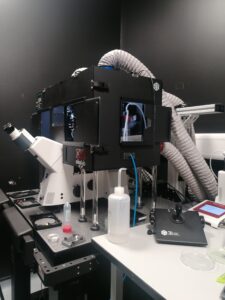 This is not something that can be achieved with standard laboratory equipment. Through the Eastern Arc Equipment Sharing Platform (ESP), I was able to access advanced imaging facilities through a collaboration with Dr Philippe Laissue at the University of Essex, and in particular a 3i Light Sheet Microscope and a spinning disc confocal microscope—both powerful tools that are relatively rare in the UK and uniquely suited to long-term live imaging.
I first learned about these facilities through my supervisor, Professor Campbell Gourlay, who encouraged me to explore this collaboration. Working with Philippe was an invaluable experience. His expertise in imaging and analysis complemented my own research perfectly, and together we were able to design experiments that pushed beyond what I had previously been able to achieve.
Eastern Arc facilitated the collaboration and paid for a three day visit to Essex. This allowed me to make full use of the time and undertake extended imaging experiments that would not have been feasible otherwise.
During my visit, I not only collected data but also received hands-on training in image acquisition and analysis techniques from Philippe. This training has been particularly impactful, as it has significantly increased my confidence in handling complex imaging workflows independently.
The outcome of this visit exceeded my expectations. I was able to generate a fantastic dataset that captures the dynamics of Candida albicans biofilm development in unprecedented detail.
Some of this work has already been recognised, with data contributing to a paper titled “A quantitative framework for multiscale analysis of Candida albicans biofilm development”, recently published in the journal Biofilm.
This experience has made a tangible difference to my research. Beyond the data itself, it has equipped me with new technical skills and a deeper understanding of how to approach imaging-based experiments.
Being introduced to the Essex research infrastructure opened my eyes to other opportunities, different institutions and new colleagues. I’d strongly encourage others to take the same step to explore how their work could similarly benefit from the ESP. There’s a huge range of facilities available across the Arc; if you don’t have the equipment at your own institution, there’s a strong possibility that one of the other EARC universities will. Stepping outside of your own lab and your own university, being able to work with others and undertake different analyses and experiments, can only be a good thing–and may even be career-changing.