
 Supporting a positive research culture is one of our three pillars of activity, and central to this is our open ‘Reciprocal’ training programme.
This gives everyone from across the consortium access to a range of existing events taking place at each university, but also the opportunity to bring together colleagues from all of our members to share their knowledge and learn from each other.
The programme is dynamic and updated frequently, so do check-in regularly to see what’s coming up. The events are free and open to all, and details of how to join them are given in the abstract for each; just click on each for more information.
The Reciprocal programme
The programme is a mix of existing events hosted by individual consortium members (marked with an asterisk), which have been opened up to staff across the consortium, and newly commissioned sessions led by Eastern Arc.
The sessions are online unless specified otherwise. They are free and open to anyone at the Eastern Arc universities.
Click on each of the sessions below to find out more and to register.
-
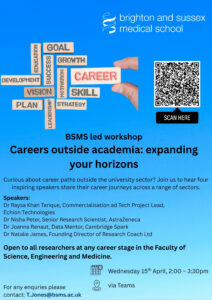 The Brighton and Sussex Medical School will be hosting this workshop exploring Careers Outside Academia: Expanding Your Horizons, taking place on Wednesday 15th April, 2:00–3:30pm via Teams. You will hear four inspiring speakers share their career journeys across a range of sectors:
- Dr Raysa Khan Tarique, Commercialisation and Tech Project Lead, Echion Technologies
- Dr Nisha Peter, Senior Research Scientist, AstraZeneca
- Dr Joanna Renaut, Data Mentor, Cambridge Spark
- Dr Natalie James, Founding Director, Research Coach Ltd
 This session is open to all researchers at any career stage. We hope you can join us for what promises to be an engaging and informative discussion.
Click on the QR code to register, and join here.
-
 To view a recording of this session, contact us
________________________
The landscape for research and innovation funding is about to change significantly: with the Innovation Strategy, the Devolution White Paper, and the Post-16 Education and Skills White Paper the Goverment has made clear that it sees the future in greater prioritisation, regionalisation, specialisation, collaboration, and innovation.
This is about to have a huge effect on the way that UKRI distributes its funding. It will shortly be launching its new Strategy 2026-31, with an increased emphasis on cross-council challenges, and ‘buckets’ of funding around four priority areas.
This session is a chance to catch up on what the future holds. It will be an open, honest and personal analysis of what is in store, and will allow for a frank conversation of where UK funding is heading. A similar session has been held at each of the universities in different fora, but this is an opportunity to hear more if you haven’t been able to attend any of these.
To register, click here.
-
 A recording of the session is now available here.
__________________
Jointly led by UEA and Kent, this session will look at how to put together a successful European Research Council (ERC) proposal.
The ERC was set up by the EU in 2007 and is the premiere European funding organisation for excellent frontier research.
It provides attractive and flexible funding to enable talented and creative individual researchers, with an emphasis on early stage researchers, and their teams to pursue the most promising avenues at the frontier of science, on the basis of EU-wide competition based solely on the criterion of excellence.
This session will provide a brief overview of the ERC, but will primarily hear from two academics who have had funding from the Council, what their experience was, and what they believe made the difference.
To register, click here.
-
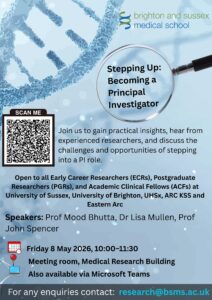 Brighton and Sussex Medical School is facilitating a hybrid session on the transition to research independence Stepping Up: Becoming a Principal Investigator on Friday 8 May from 10:00–11:30 at Meeting room, Medical Research Building and via Teams. This interactive session will explore the journey from researcher to independent senior Principal Investigators (Dr Lisa Mullen and Professors Mood Bhutta and John Spencer), offering practical insights into developing leadership, building a research vision, and navigating the early stages of leading a research programme.
The workshop is open to Early Career Researchers (ECRs), Postgraduate Researchers (PGRs), and Academic Clinical Fellows (ACFs) across BSMS, the University of Sussex, the University of Brighton, UHSx, ARC KSS and Eastern Arc.
-
 Led by Hannah Crago (Essex), this workshop will introduce key aspects of copyright in publishing and teaching.
Attendees will become familiar with copyright considerations when publishing different outputs, in both open and closed access. Creative commons licences will also be explored, alongside the blanket copyright licences that the UK Higher education institutions tend to utilise for teaching. Furthermore, common copyright questions will be addressed and the importance of appreciating the situation-dependent nature of copyright will be highlighted.
By the end of the workshop, attendees will have a better understanding of different terms and licences available for publishing in different formats, as well as copyright considerations when creating, using, or sharing third-party materials for teaching.
There will be time at the end for questions and discussion.
To find out more and register, click here.
-
 This session provides an opportunity for anyone who has applied to take part in the EARC Mentoring Scheme to hear more about the scheme itself, how it works, and the expectations for both mentor and mentee.
You can find out more about the Mentoring Scheme here, where you can also register for this year’s programme (deadline 17 April 2026).
-
To be led by Kent and Essex; details available shortly.
-
Delivered in collaboration with Constellation Marketing, this interactive session is designed specifically for technical professionals across Eastern Arc. It will focus on how to recognise, articulate, and showcase your expertise, helping you strengthen your professional profile and increase the visibility of technical roles across the University.
What to expect:
- Practical tips on identifying and communicating your skills and experience
- Guidance on writing clear, compelling staff profiles
- Insights into how a strong technical profile supports career development and collaboration
-
Hosted by Brighton and Sussex Medical School, these ALS sessions aim to provide a confidential, supportive space to share experiences, explore issues, and develop practical strategies for those having to balance clinical and academic roles.To receive a Teams invitation, please email Deeptima Massey at d.massey@bsms.ac.uk
-
To be led by Kent, and involving Kent and Essex colleagues. Details will be available shortly.
-
Details to be confirmed.
-
This event enables participants to hear – first hand – from academic colleagues who have been and still are involved in collaborative research and innovation projects funded by the EU. Designed as a panel discussion, with academics from each of the EARC universities, all of whom have significant experience of getting funding from (and, in some cases, reviewing for) the European Uniion. it will be chaired by Eastern Arc Director, Phil Ward.
Details of the panellists, and information on how to register, will be available shortly.
-
To be led by Essex. Details to be confirmed.
-
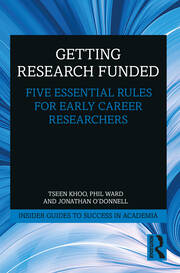 There is an increasing expectation to secure research funding, but where do you begin if you’ve not had the experience of putting together a successful application before?
Phil Ward, in collaboration with Australian colleagues Jonathan O’Donnell and Tseen Khoo (who write the Researcher Whisperer blog) have put together an approachable and simple guide to doing so, breaking down the process into five ‘rules of Grant Club’, explaining the culture of grantseeking, and the tactics necessary for proposal writing.
The session is based on the essential ‘how to’ guide, Getting Research Funded, and offers clear strategies on how to stage your research and understand project development, find aligned funding bodies and schemes, build strong research teams and partnerships, get the project right and effectively plan your grantseeking.
Recording
A recording of the session is available here.
-
To be led by the University of Sussex; details to follow.
-
To be led by the universities of Kent and Sussex; details to follow.
-
Led by Ian Badger (Kent) and Helen Webb (Sussex), this workshop will provide an introduction to key aspects of managing, sharing and reusing research data.
Attendees will be introduced to why and how research data can be shared, including considerations around ethics, consent and confidentiality, and copyright and the use of existing data resources. The workshop will also provide an overview of practical aspects of good data management, including data description, contextualisation and documentation; data formats and software; and data storage, back-up and security.
We will also consider the requirements of research funders and journals, and offer practical tips for both sharing your own research data and finding existing data for use in research. We will signpost towards support and resources at your own institution.
By the end of the workshop, attendees will have a better understanding of the key principles of good research data management and the considerations involved in storing, documenting, sharing and reusing research data.
There will be time at the end for questions and discussion.
To register, click here.
-
This session on Demystifying the NIHR will be led by Brighton and Sussex Medical School. We will hear from Professors Carrie Llewellyn and Mood Bhutta, both of whom have held large NIHR grants and served on NIHR review panels.
They will share their perspectives on the NIHR funding landscape, the projects they have led, what makes a strong application, and how proposals are assessed. The session will help participants better understand the funder’s priorities, expectations, and application processes. It will also explore key elements of proposal development, including identifying suitable funding opportunities, building competitive applications, and aligning research ideas with NIHR priorities. Participants will have a brief opportunity for questions at the end.
This session is open to all researchers who are part of Eastern Arc consortium, ARC KSS, University of Sussex, University of Brighton and University Hospitals Sussex NHS Trust.
Please register here and then a Teams link will be shared.
-
To be led by the universities of Essex and Kent; details to follow.
-
Led by Ian Badger (Kent), this workshop will explore practical ways researchers can increase the visibility and discoverability of themselves and their research, and introduce some of the metrics used to understand research reach and impact.Attendees will consider the role of online research profiles and identifiers, including institutional staff profiles, ORCID, Google Scholar and professional and social platforms such as LinkedIn. We will look at how these different profiles can work together, the importance of keeping information about your research accurate and discoverable, and the role of contributor information and credit taxonomies in recognising research contributions.The workshop will also introduce some of the different ways in which research is measured, including journal-level metrics, citation counts, the h-index and altmetrics. We will consider what these measures can – and cannot – tell us, and explore the principles of responsible research assessment, including DORA.By the end of the workshop, attendees will have a better understanding of the tools available to develop their online research presence, increase the visibility of their work, and interpret commonly encountered research metrics responsibly.There will be time at the end for questions and discussion.To register, click here.
-
To be led by the University of Kent; details to follow
-
To be led by the universities of Kent and Essex; details to follow.
-
To be led by the University of Essex; details to follow.
-
To be led by the University of Kent; details to follow
-
To be led by the University of Essex; details to follow
-
To be led by the University of Essex, details to follow.
-
To be led by the University of Essex, details to follow.
-
To be led by UEA; details to follow.
-
Led by Hannah Crago (Essex), this workshop will introduce key aspects of copyright in publishing and teaching.
Attendees will become familiar with copyright considerations when publishing different outputs, in both open and closed access. Creative commons licences will also be explored, alongside the blanket copyright licences that the UK Higher education institutions tend to utilise for teaching. Furthermore, common copyright questions will be addressed and the importance of appreciating the situation-dependent nature of copyright will be highlighted.
By the end of the workshop, attendees will have a better understanding of different terms and licences available for publishing in different formats, as well as copyright considerations when creating, using, or sharing third-party materials for teaching.
There will be time at the end for questions and discussion.
Registration details to follow.
 Click on the QR code in the poster to register.
Asynchronous resources
As well as the programme, we have a series of resources such as recordings, booklets, and websites available to Eastern Arc colleagues. Details and a link to the dedicated webpage will be available shortly.